
All the versions of this article: [English] [français]
– Seeds of diversity: geometric morphometrics as a proxy for varietal structure and identification in date palms of the oasis of al-ʿUlā, Saudi Arabia [temporary title]
– Vincent Bonhomme, Sarah Ivorra, Muneera Almssallem, Randah Alqurashi, Pauline Burger, Jean-Frédéric Terral, Michael Purugganan, Vincent Battesti, Muriel Gros-Balthazard (provisional authors and rank)
– Abstract:
Farmers can maintain substantial diversity in clonally propagated crops by combining vegetative propagation of selected plants with the incorporation of seed-derived individuals. We examined seed phenotypic diversity and its organisation into locally recognised named types in al-ʿUlā, Saudi Arabia.
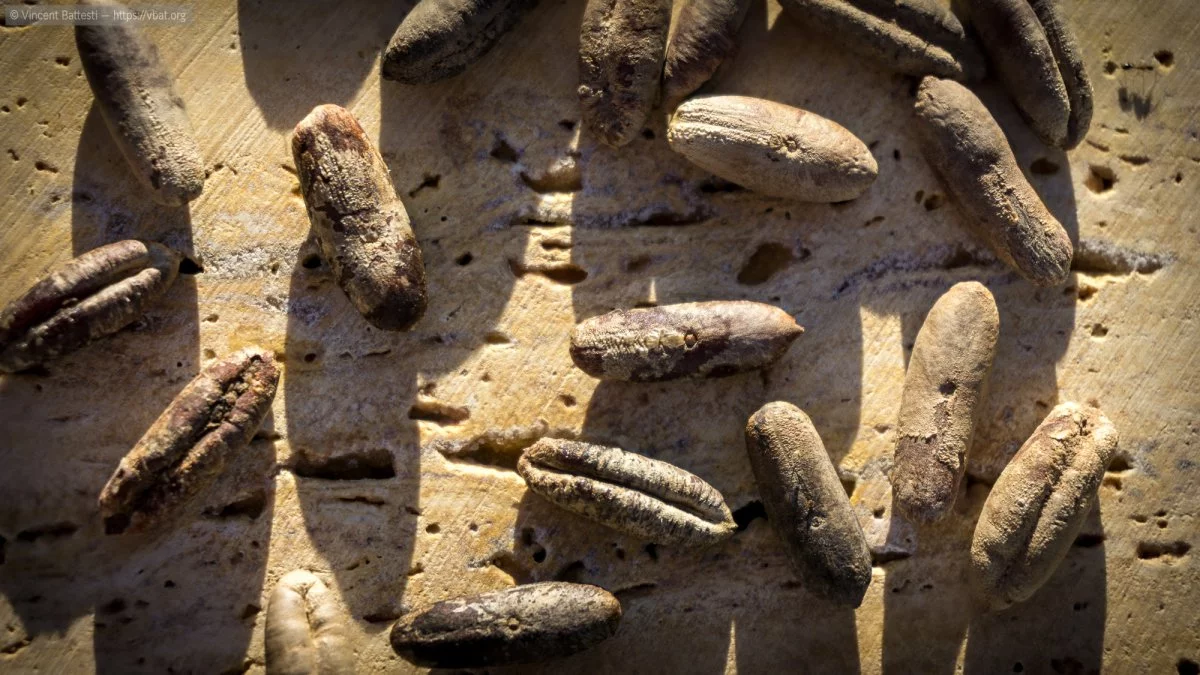
We analysed seed size and shape in 1,483 seeds from 76 female palms representing 64 named types, compared with 5,248 seeds across North Africa and West Asia, integrating morphometrics with ethnobotanical evidence.
The oasis of al-ʿUlā encompassed 90% of cultivated date palm seed-shape diversity. Presumed clonal cultivars and ethnovarieties showed strong within-name coherence, whereas categories encompassing seed-derived palms were heterogeneous. Lexical groupings reflected phenotypic similarity, common origin, or shared meaning. Discrimination among named types reached over 90% accuracy after excluding heterogeneous seed-derived accessions.
A single oasis can thus maintain most cultivated seed-shape diversity within a biologically heterogeneous local classification system. Combining ethnobotany and morphometrics provides a quantitative framework for analysing how farmers generate, maintain, and organise agrobiodiversity through interconnected biological and cultural processes.
– Article to be submitted in autumn 2026.
➡︎ Work produced under the project al-ʿUlā DPA ❎.