All the versions of this article: [English] [français]
An important milestone has now been reached — during the springtime 2025 — in the work on the historical demography of Nocario: the collation of the surviving and accessible registers, their digital reproduction and their systematic examination are now complete.
The GENS project is based on three complementary components that should be distinguished from one another:
- the GENS documentary corpus, comprising digital reproductions — our own scans — of the registers and their archival references;
- the GENS records database, comprising the tables of data and transcriptions compiled from these reproductions;
- the GENS genealogical database, in which individuals, their life histories and their family relationships will be reconstructed in accordance with the international GEDCOM standard.
Together, these three components form the GENS information system of the Castagniccia.
– The GENS Documentary Corpus
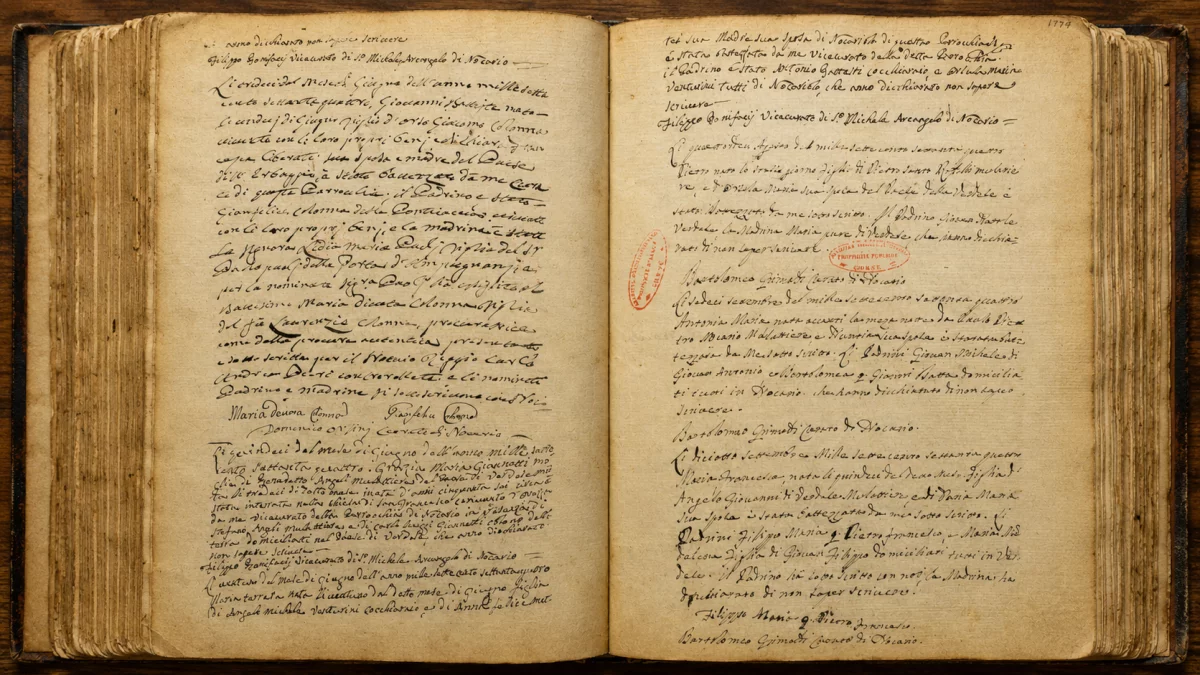
The GENS documentary corpus comprises complete digital reproductions of the registers available for Nocario:
–* the parish registers from the Ancien Régime held at the Archives départementales de Haute-Corse and in the Franciscorsa collection, maintained by a Franciscan association in Bastia;
–* the municipality’s civil registration registers, with priority given to the copies kept at the town hall, particularly because they contain valuable marginal annotations, and supplemented where necessary by those held at the Departmental Archives;
–* marriage records identified in other municipalities of the Orezza Valley when they concern a resident of Nocario.
Taken together, this documentation covers, roughly speaking, two centuries, from the 1770s to the 1970s, and concerns the three hamlets that now form the municipality of Nocario.
This work builds upon the initial records compiled with the assistance of Claire Battesti and Christian Badoual-Battesti†. A new intensive and systematic phase was launched in 2018 with François Ireton. The examination of the difficult parish registers from the Ancien Régime also benefited from the exceptionally meticulous work of Madeleine Laurens.
– The GENS Records Database
Using the digital reproductions, all the surviving and accessible register entries were recorded in structured tables. Together, these form the GENS records database.
This database brings together the information contained in baptism or birth, marriage, and burial or death records. It preserves the forms in which names, given names, occupations, places of residence and other information appear in the documents.
The approximate totals are 2,000 births or baptisms, 550 marriages, and 1,500 deaths or burials. These figures describe the events recorded in the registers: the same person may naturally appear in numerous records over the course of their life, as the subject of the record, a spouse, a parent or in another capacity.
To say that the systematic examination is complete means that all the surviving and accessible registers have been examined and deciphered, and that their entries have been meticulously entered into the database. It does not mean that the database is definitively closed, frozen or free from errors. Some readings still need to be checked; spellings, dates or identifications may require correction; duplicates must be resolved; and gaps in the documentary record can sometimes be partially offset by cross-referencing different records.
– From the GENS Records Database to the GENS Genealogical Database
The next stage is the systematic reconstruction of individuals and families in the GENS genealogical database, structured according to the GEDCOM standard.
Each individual identified during this reconstruction will be assigned a unique and persistent identifier: their “GENS Individual ID”. This identifier will then be entered into the records database in the fields corresponding to each documentary occurrence of that person.
Linking the data back to the tables is essential. It makes it possible to match the different occurrences of the same individual, to link each person to the records on which their identification is based, and to trace the genealogical data directly back to the sources underpinning them.
This operation is as valuable as it is difficult. Homonymy is extremely common and at times almost systematic. The same given names are also regularly bestowed upon several members of a family — often passed from grandparents to grandchildren — or reused for a later child following the death of the previous one. A further difficulty arises from variations in the written forms of given names according to the language in which the records were drawn up, particularly between Italian — often Tuscan in tradition and sometimes Corsicanised — and French.
The same person may therefore appear under several forms of name over the course of their life; conversely, several contemporaries may bear exactly the same given name and surname. Record linkage cannot therefore be based on names alone. It requires the cross-checking of dates, places, kinship relations, spouses, occupations, places of residence and every other available piece of biographical information.
The records database thus preserves the documentary trail and the forms actually encountered in the registers, while the genealogical database establishes individuals’ identities and relationships. Moving from one database to the other, and then feeding the identifiers back into the tables, forms a continuous process of verification and correction.
The completion of the systematic examination therefore marks not the end of the work, but the transition from one stage to another: from the systematic compilation of data to the critical reconstruction of individuals, families and, ultimately, the Nucarinchi population over nearly two centuries.