
Stages #1 & 2
Work conducted by Vincent Battesti and François Ireton._ This strand of the project has been active since 2018.
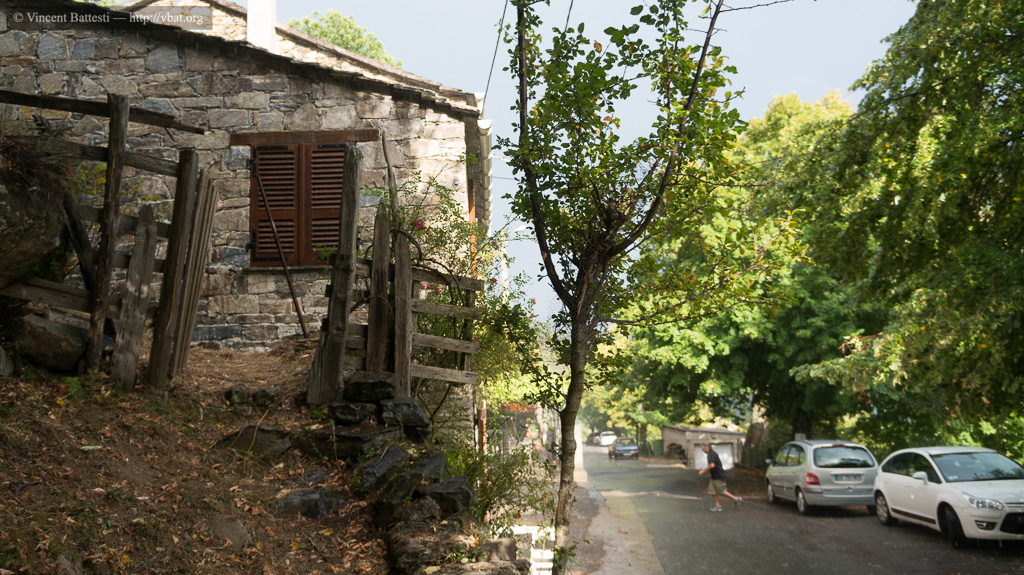
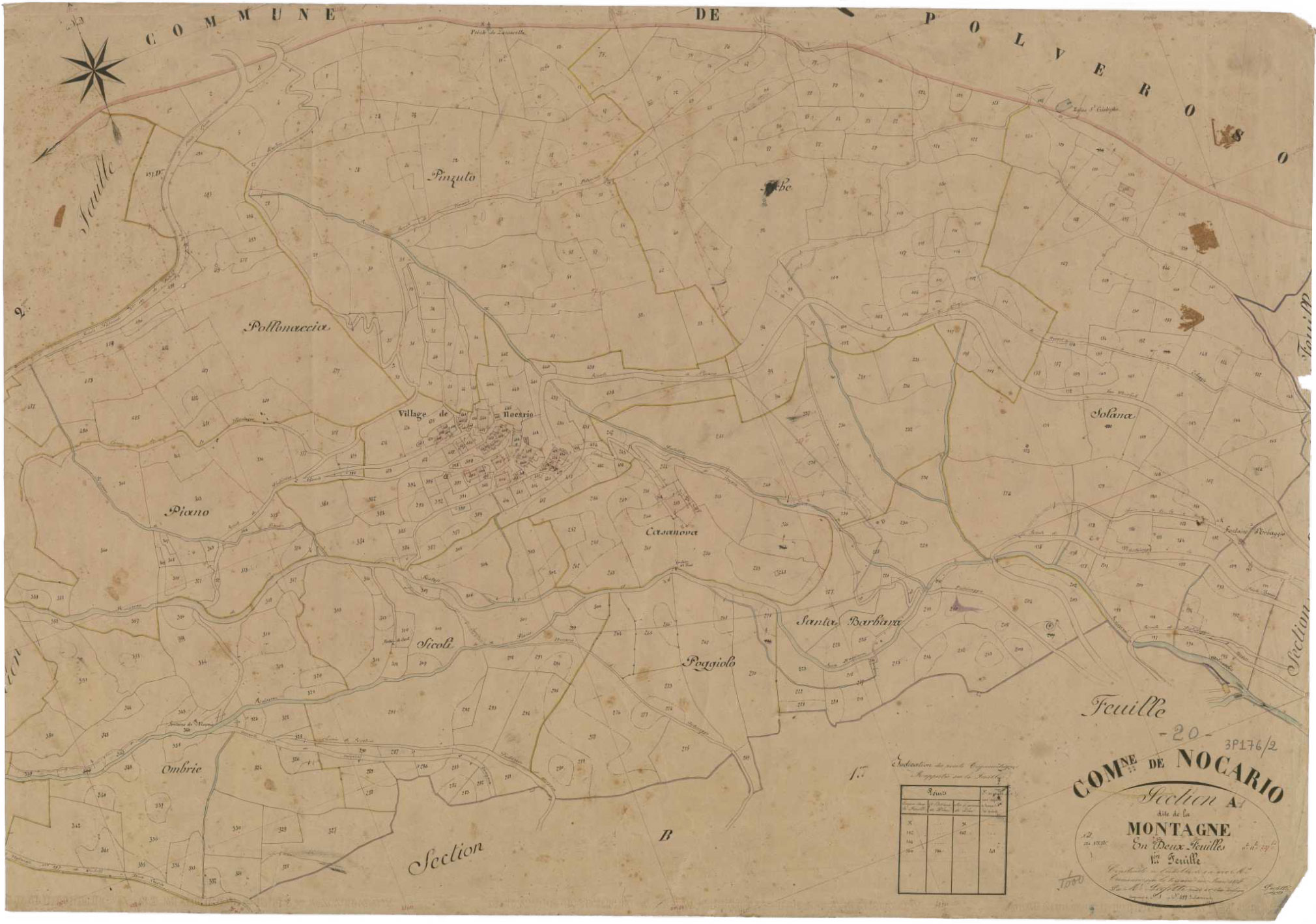
Our research examines changes in population and land occupation in Castagniccia from the late eighteenth century to the present day. It combines an approach grounded in historical demography (stage #1) with a history of land tenure (stage #2). The study focuses on the small Castagniccia — the heart of this region, namely the Orezza Valley — and, for the most systematic investigations, on the municipality of Nocario.
We combine oral and archival sources._ For civil registration material, we give priority to the registers held at the town hall and, where these are unavailable or require supplementation, to those held at the Archives of Corsica — Cismonte, in Bastia (formerly the Departmental Archives of Haute-Corse, ADHC). For cadastral data, we also rely on collaboration with these Archives and with the staff of the former departmental authority of Haute-Corse, and subsequently of the Cullettività di Corsica/Collectivity of Corsica. Since 1 January 2018, this territorial authority with special status has replaced the former Territorial Authority of Corsica and the two departmental authorities of Corse-du-Sud and Haute-Corse.
For its historical demography strand, the project is progressively developing an information system called “GENS”. It brings together the GENS documentary corpus — the digital reproductions of the registers and their archival references —, the GENS records database — the tables produced through their systematic examination —, and the GENS genealogical database, structured according to the GEDCOM standard, in which individuals, their life histories and their family relationships are reconstructed.
Each individual identified in the genealogical database is assigned a unique and persistent identifier, their “GENS Individual ID”. This identifier is entered into the records database for each documentary occurrence attributed to that person, linking the different records concerning them and providing direct access to the sources on which their identification is based.

Portfolio