
All the versions of this article: [English] [français]
– Lecture (in French): Peut-on domestiquer une oasis ?
Possible translation: Can an Oasis Be Domesticated?
given as part of the Rencontres “Tête-à-tête avec un chercheur”,
Musée de l’Homme, Muséum national d’histoire naturelle, Paris (France),
10 June 2026, 3 p.m. - 4 p.m.
– On the Musée de l’Homme website: https://www.museedelhomme.fr/fr/ren...
– Abstract:
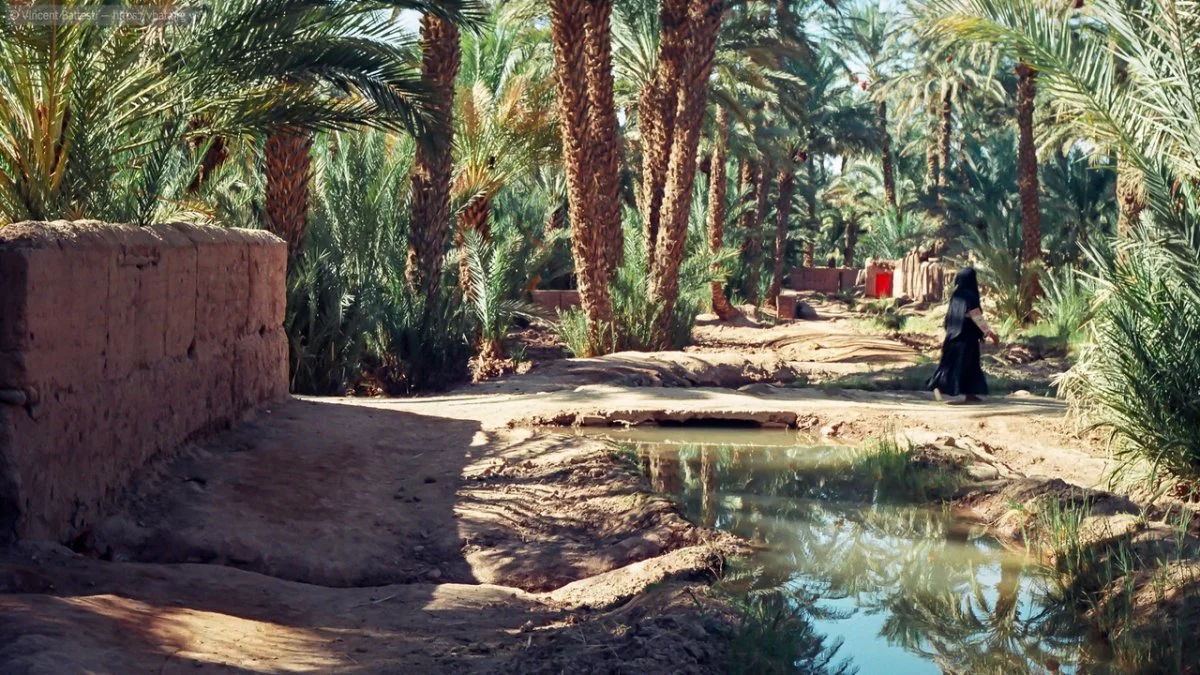
In the deserts of the Sahara and Arabia, oases have enabled human societies to establish themselves durably and flourish for millennia. They are not merely water sources bordered by palm trees, but environments patiently shaped over time. Living in an oasis entails acting upon living organisms. In its anthropological sense, domestication is a long-term process through which species are incorporated into, and transformed within, the human world. The date palm provides an emblematic example: its reproduction, nutrition, and protection are carefully directed and regulated.
Yet domestication is never definitively achieved. It requires the continual maintenance of relationships between humans and nonhumans. From this premise, I will propose a shift in scale: what if the oasis itself could be understood as the outcome of a form of domestication? The oasis agroecosystem—date palms, associated crops, soils, water, and social rules—may be approached as the product of a multiscalar process of domestication, through which environments and societies are jointly transformed.