
All the versions of this article: [English] [français]
– Lecture (in French): Inhabiting deserts: the ecologies of societies in the Sahara and Arabia?
Original title: Comment habiter les déserts ? Les écologies des sociétés du Sahara et de l’Arabie?
given as part of training for secondary school teachers, with the DIREF of the Museum and the DAAAC of the Académie de Versailles,
Jardin des Plantes, Muséum national d’histoire naturelle, Paris (France)
Dec. 4, 2025 (11:30 am-1:15 pm)
– Abstract:
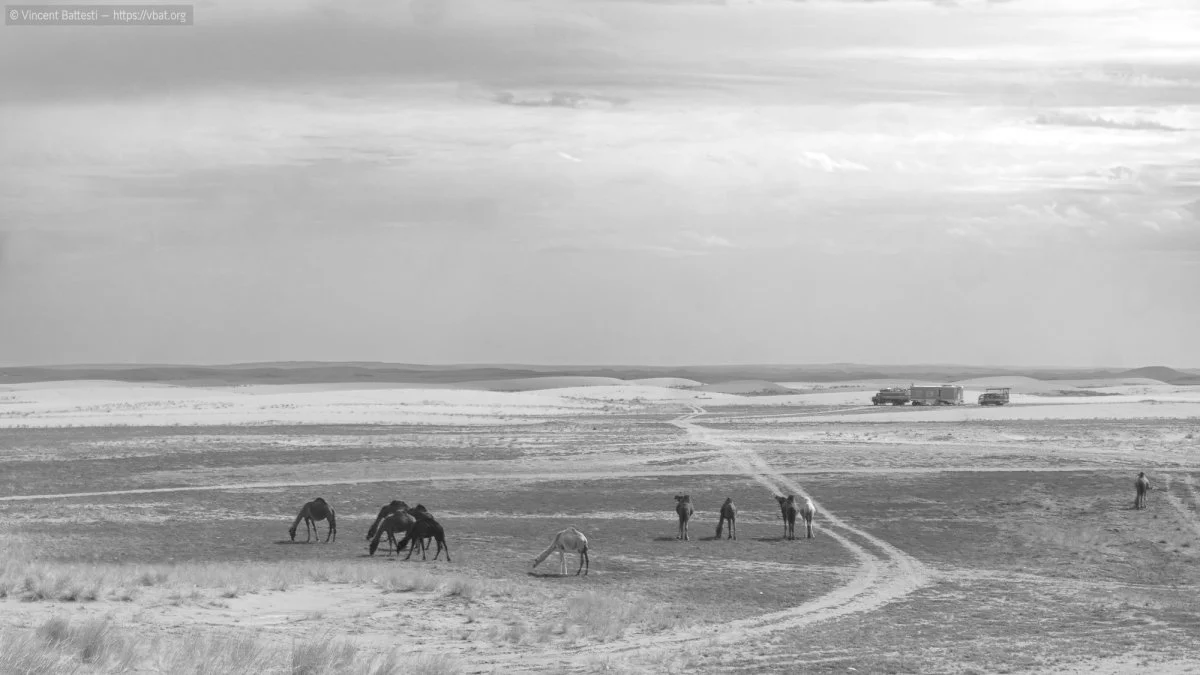
In the deserts of the Sahara and Arabia, modes of production rely on two major socio-ecological strategies: anchoring, which locally transforms the environment, and mobility, which adjusts to its variability. The oasis represents the most accomplished expression of anchoring—a form of socio-ecological engineering based on the collective management of water, the creation of microclimates, and agricultural intensification. Mobility, by contrast, takes two distinct forms: hunting and gathering, which draw on scattered and episodic resources, and pastoral nomadism, which converts sparse vegetation into animal production through finely tuned knowledge of territories and their temporalities. Between these poles, caravan circulation—an economic activity grounded in routes, alliances, and risk management—embodies the structural interdependence between sedentary cultivators and pastoral nomads: it links oases together, articulates their economies, and reveals the complementarity of desert modes of production. Far from being archaic, these strategies constitute sophisticated responses to the challenge of desert habitability and help illuminate how we might understand contemporary transformations.